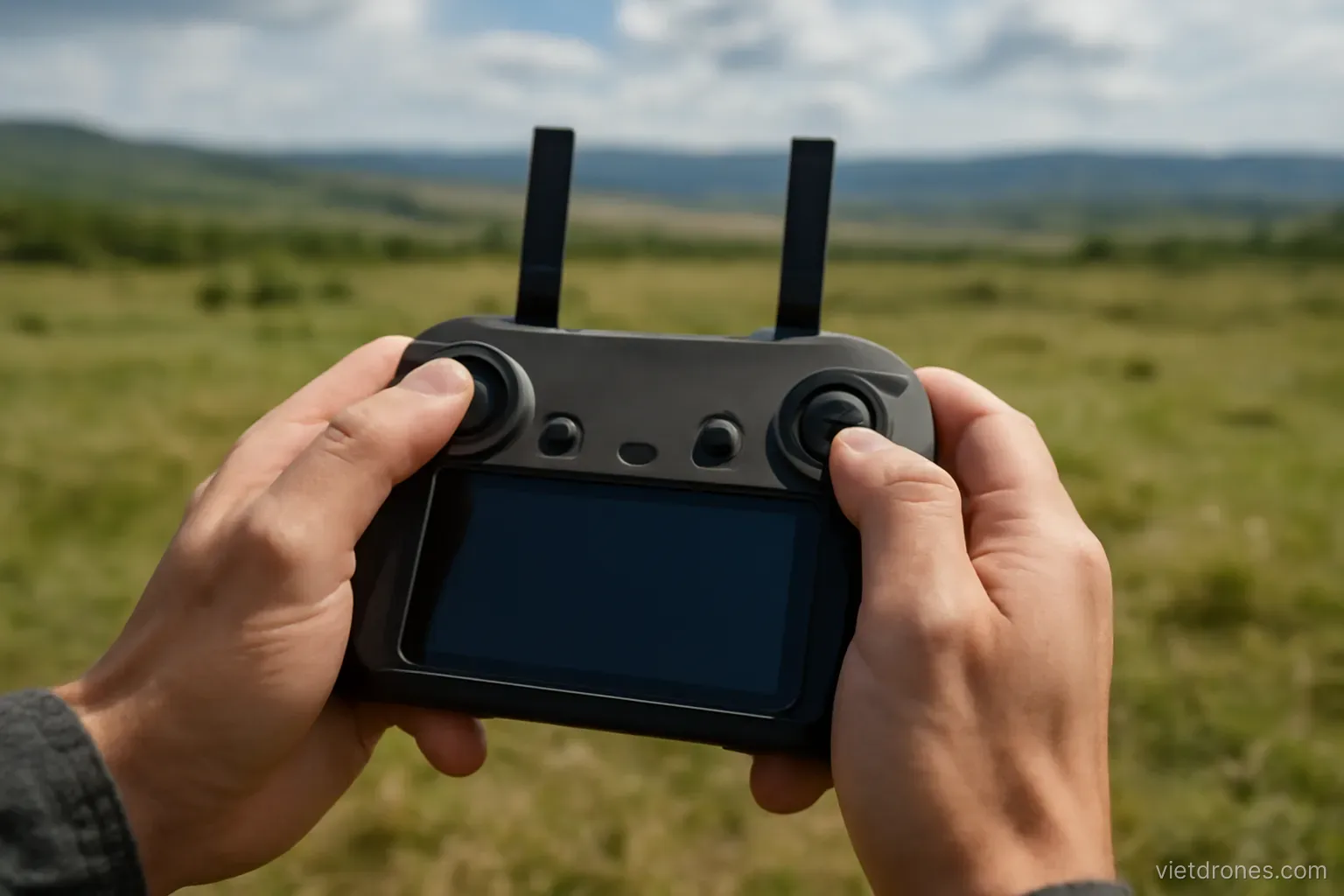
Two pilots flying the same drone over the same landscape can produce footage that looks entirely different. Almost all of that difference lives in the last centimetre of stick travel.
How to hold and move the sticks
Use fingertips, not fists. Pinching the stick between thumb and forefinger gives far finer control than pushing with a thumb alone.
Rest your hands. Unsupported arms tire quickly, and tired arms produce shaky inputs within a few minutes.
Think pressure, not position. Aim to apply gradually increasing pressure rather than moving to a position and holding it.
Ease in and ease out. Every move should start and end gradually, exactly like a well-operated camera on the ground.
Never release a stick suddenly. Letting go causes an abrupt stop that no stabilisation can hide.
Use small inputs. Most cinematic flying happens in the first third of stick travel.
One input at a time while learning. Combining moves comes later and is much easier once each is smooth alone.
Breathe. Holding your breath tightens the hands, and it happens more than pilots realise.
Watch your own hands occasionally. Many pilots are surprised by how abrupt their inputs look from outside.
Controller and software settings
Use the slowest flight mode. Cine or tripod modes reduce maximum speed and soften response, which is exactly what filming wants.
Reduce maximum angular rates. Lower yaw and pitch rates make it physically harder to fly badly.
Add exponential curve. This softens response near centre while keeping full speed available at the extremes.
Slow the gimbal. Default gimbal tilt speed is usually far too fast for smooth camera work.
Set gimbal smoothness high. It adds a slight lag that removes small jitters.
Turn off any sharpening. It cannot be undone later and it makes footage look harsh.
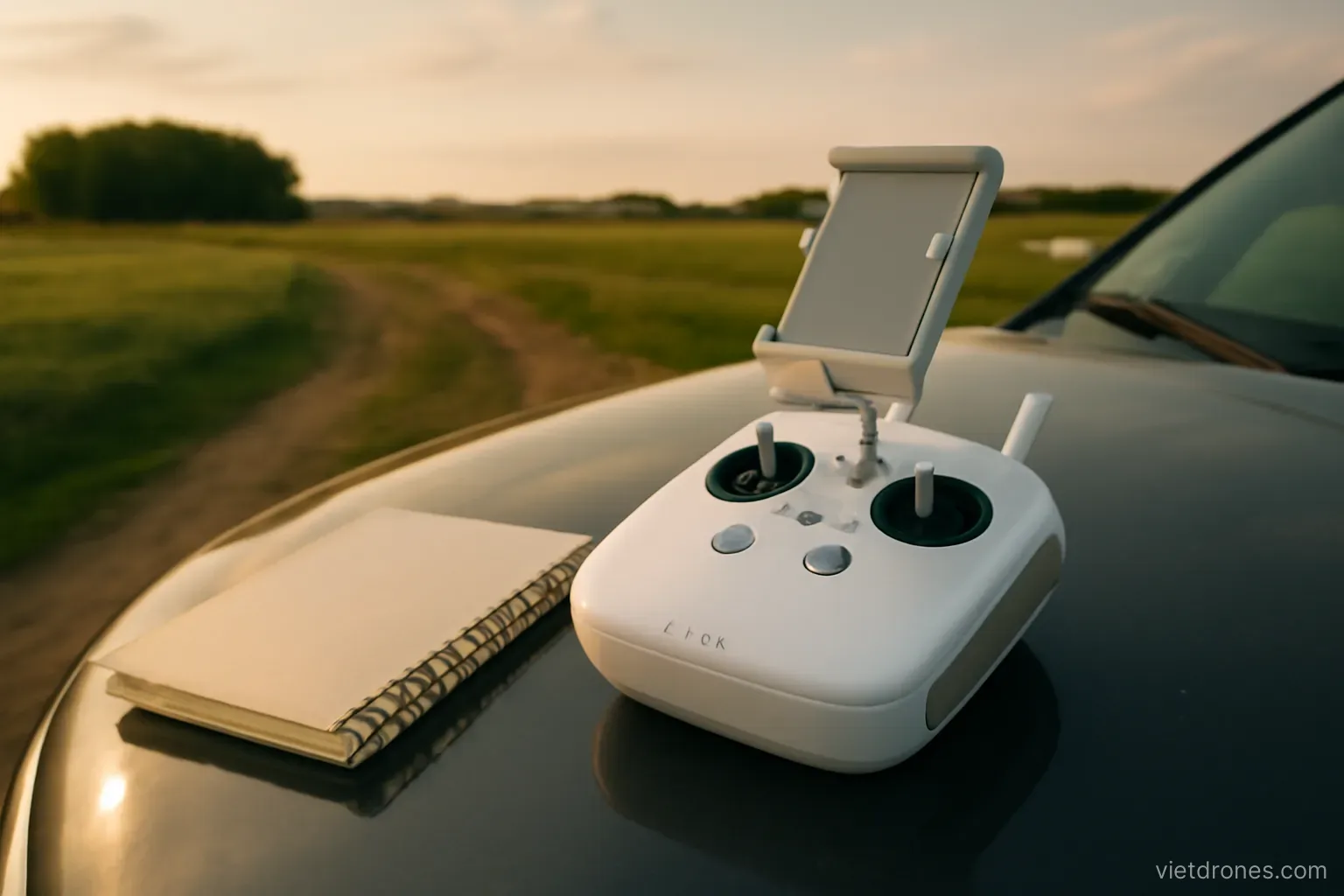
Check your stick calibration. A worn or miscalibrated stick will not return cleanly to centre.
Save profiles. One set of settings for filming, another for practice or windy conditions.
Do not fight the settings. If a move needs more speed than the mode allows, change modes rather than jamming the stick.
Flying in wind
Wind is the main enemy of smoothness. The drone constantly corrects, and those corrections show up as small oscillations in the footage.
Fly into or with the wind. Crosswind flight requires continuous correction and produces the worst results.
Slow down further. Slower flight gives the stabilisation system more time to absorb gusts.
Lower altitude is often calmer. Though terrain-induced turbulence can reverse this near cliffs and buildings.
Expect worse results near obstacles. Air spilling over ridges and around buildings is turbulent and unpredictable.
Watch the horizon in the feed. Small rhythmic tilting means the drone is working hard against the wind.
Shorten the shots. Grab a usable few seconds rather than a long ruined take.
Reshoot rather than fix. Wind-induced micro-jitter is very difficult to remove in editing.
Know when to stop. Beyond a certain strength, no technique will produce smooth footage.
Habits that produce jerky footage
Starting to record after the move begins. The first second is always the roughest and you need it as handle.
Stopping the move before stopping the recording. Same problem at the other end.
Correcting mid-shot. A visible correction ruins a take. Better to fly it again.
Chasing the subject. Constant small adjustments to keep something centred read as nervousness.
Flying too fast. Speed amplifies every input error.
Changing direction sharply. Direction changes need to be planned and eased into.
Yawing while moving forward carelessly. The combination is powerful and unforgiving of rough input.
Flying while distracted. Talking to someone during a take shows up in the footage.
Trying to fix it in editing. Stabilisation crops and warps, and it never fully rescues a badly flown shot.
Practising deliberately
Pick one move per session. Repetition of a single move builds far more skill than flying around randomly.
Use a fixed subject. A tree or a post in an open field gives you something to judge consistency against.
Review every flight. Watch the footage back specifically looking at where the movement wobbles.
Count seconds. Aim for a full ten seconds of usable smooth movement, which is longer than it sounds.
Practise in mild wind deliberately. Skills learned in perfect conditions vanish the first time it is breezy.
Practise the endings. Stopping smoothly is harder than starting and gets far less practice.
Fly the same location repeatedly. Familiarity removes the navigational load and lets you focus on the camera.
Use a simulator for stick discipline. Cheap practice with no consequences, especially for coordinated moves.
Be patient. Smoothness arrives after tens of hours, not after reading about it.
Frequently asked questions
What is the single biggest cause of jerky drone footage?
Abrupt stick movement, particularly releasing a stick suddenly at the end of a move. Every input should ease in and ease out gradually.
Which controller settings help most?
The slowest flight mode, reduced maximum angular rates, exponential curves near stick centre, and a much slower gimbal tilt speed than the default.
How should I fly when it is windy?
Fly into or with the wind rather than across it, slow down further, shorten each shot, and accept that beyond a certain strength nothing will look smooth.
How long does it take to fly smoothly?
Tens of hours of deliberate practice. Repeating one move per session against a fixed subject builds skill far faster than general flying around.
More in Care and repair and Safe and legal flying.