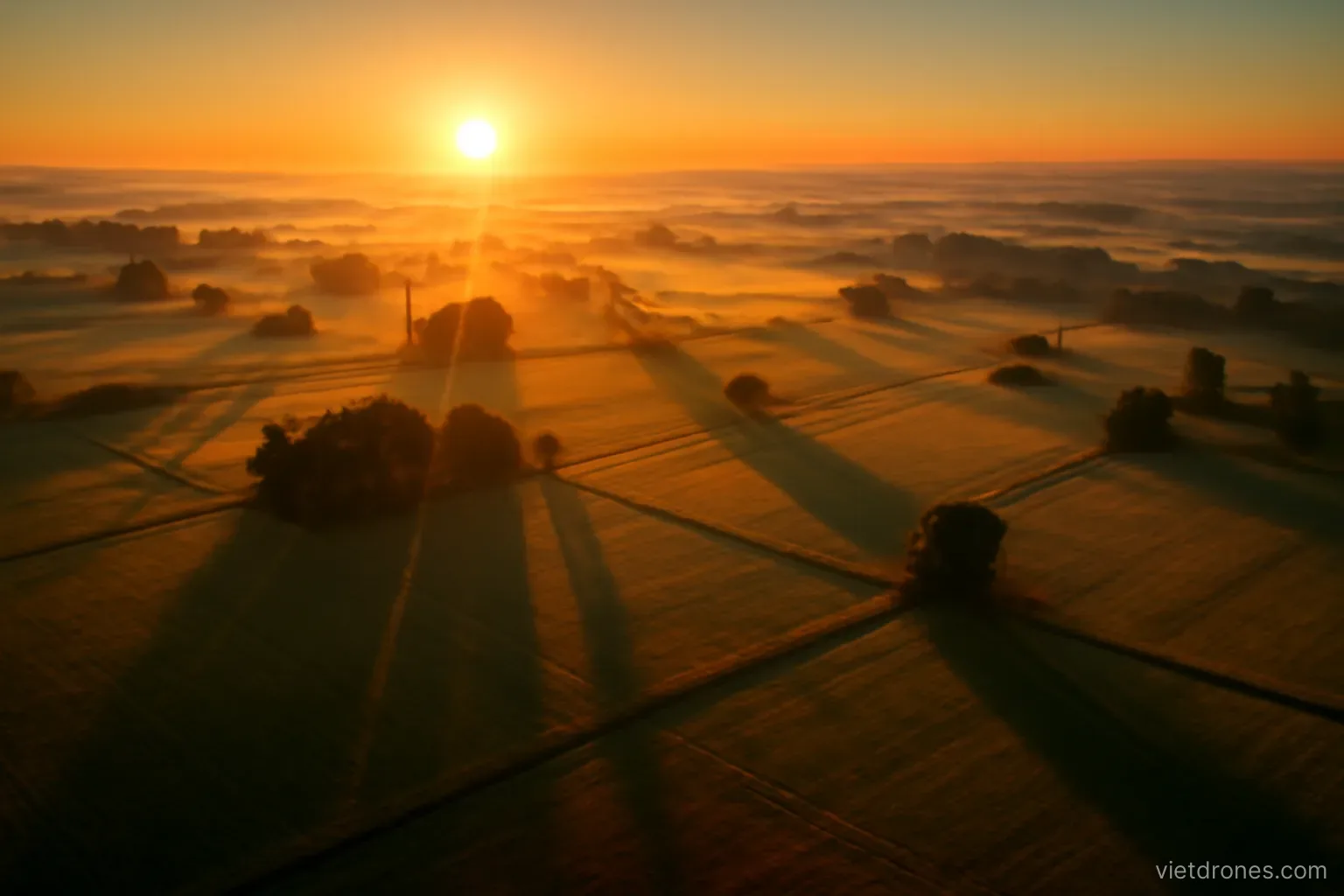
Drone cameras have small sensors and limited dynamic range, so light matters more than it does for larger cameras. Half of shooting well is knowing which conditions to work with and which to avoid.
Golden hour
The best light for aerial work. Low sun creates long shadows, and shadows are what give an aerial view its sense of form.
Warm colour without correction. Set white balance manually to preserve the warmth rather than letting auto neutralise it.
It changes fast. Exposure shifts noticeably within ten minutes, so check the histogram often.
Arrive early. Set up before the light arrives rather than during it.
Shoot away from the sun first. Front-lit landscape shots hold detail best.
Then shoot into it. Backlit shots are dramatic but need very careful exposure.
Watch for your own shadow. Long shadows include the drone's, especially at low altitude.
Prepare the shot list in advance. The window is short and there is no time to plan in the air.
Sunrise is usually calmer. Wind is often lighter in the early morning than at sunset.
Harsh midday sun
The worst light for aerial work. Overhead sun removes shadows and flattens the landscape completely.
Contrast is extreme. Bright surfaces and dark shadows exceed the sensor's range.
Use a strong ND filter. ND32 or ND64 to keep shutter and ISO where they belong.
Expose for the highlights. Protect sky and bright surfaces, then lift shadows in editing.
Look for subjects that suit it. Water, sand, geometric patterns and colourful markets read well.
Go higher and more abstract. Top-down pattern shots work when texture and form do not.
A polariser helps considerably. Cutting glare from water and reducing haze.
Avoid landscape shots. They will look flat regardless of settings.
Consider not flying. Two hours later the same location will look dramatically better.
Overcast conditions
Soft and even light. Easy to expose and forgiving of mistakes.
Low contrast. Footage looks flat straight out of the camera and needs contrast added in editing.
Colours can look dull. Green landscapes in particular lose vibrance.
Set white balance manually. Overcast light is cool, and auto white balance drifts across shots.
Weak or no ND needed. ND4 or ND8 is usually sufficient.
The sky is a problem. A white overcast sky is featureless and easily blown out.
Compose to exclude it. Angle the camera down and let the ground fill the frame.
Good for detail and texture. Even light shows surface texture clearly without harsh shadows.
Good for filming people. No squinting and no harsh facial shadows.
Backlight and shooting into the sun
Dramatic but demanding. Silhouettes, rim light and reflections are only available this way.
Expect flare. Small drone lenses flare readily, and filters can make it worse.
Clean the lens first. Dust and fingerprints turn mild flare into a washed-out image.
Expose for the highlights. Accept dark foreground rather than blowing out the sky.
Or commit to silhouette. Deliberately dark subjects against a bright sky can be very strong.
Keep the sun just outside frame. Often the best compromise between drama and usability.
Use a subject to block it. Partially hiding the sun behind a building or tree controls flare.
Shoot extra takes. Backlit shots fail more often, so shoot more than you think you need.
Grade carefully. Lifting shadows in backlit footage exposes noise quickly on a small sensor.
Low light after sunset
The hardest condition. Small sensors have little to work with once the sun is down.
Remove all filters. Every stop matters now.
Accept a higher ISO. Within the ceiling you have tested for your own drone.
Consider a lower frame rate. Twenty-four frames allows a slower shutter than sixty does.
Fly slowly. A slower shutter smears motion, so slow flight keeps the image usable.
Find bright subjects. City lights, illuminated buildings, roads with traffic.
Blue hour is the sweet spot. Shortly after sunset, when sky and artificial light are balanced.
Obstacle sensors stop working. They need light, so fly with far more caution.
Take off before it is fully dark. Setting up and locating a landing point while there is still light makes the whole flight far safer.
Know the rules. Night flight is separately regulated in many places and often requires specific permission.
Frequently asked questions
Why is midday the worst time for aerial filming?
Overhead sun removes shadows, which are what give aerial views their sense of form, and the contrast between bright surfaces and shadow exceeds the sensor's range.
How should I expose a backlit shot?
For the highlights, accepting a dark foreground rather than blowing out the sky — or commit fully to silhouette, which can be very effective.
What settings suit overcast conditions?
Weak ND filtration, manual white balance to stop colour drift, and composition that excludes the featureless white sky by angling the camera down.
What changes when flying after sunset?
Remove all filters, accept higher ISO, use a lower frame rate and fly slowly — and note that obstacle sensors stop working and night flight is separately regulated.
More in Choosing a drone and Safe and legal flying.